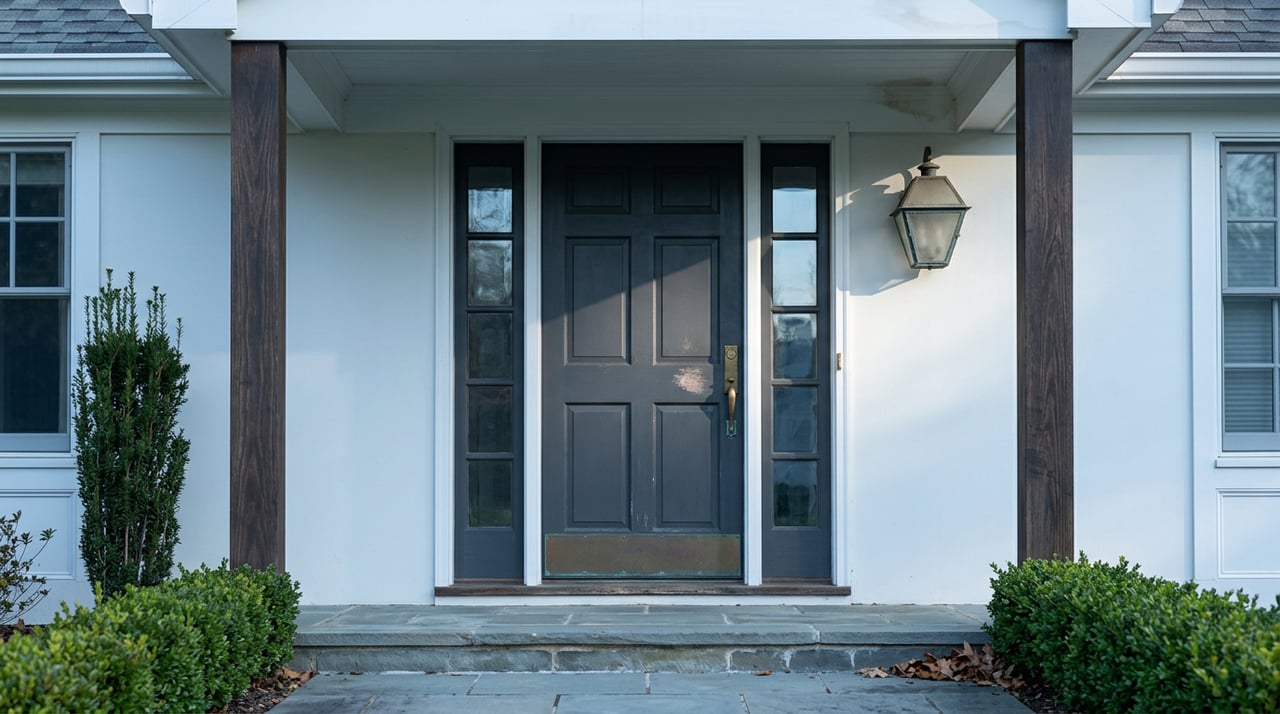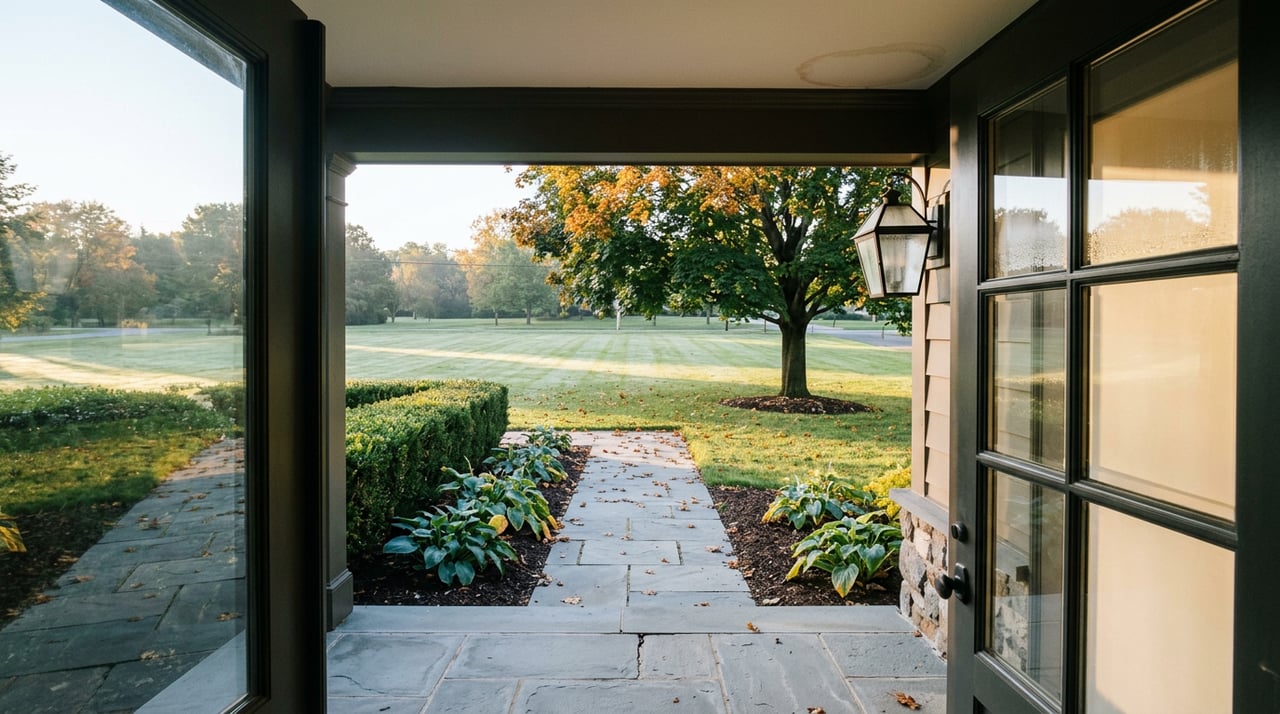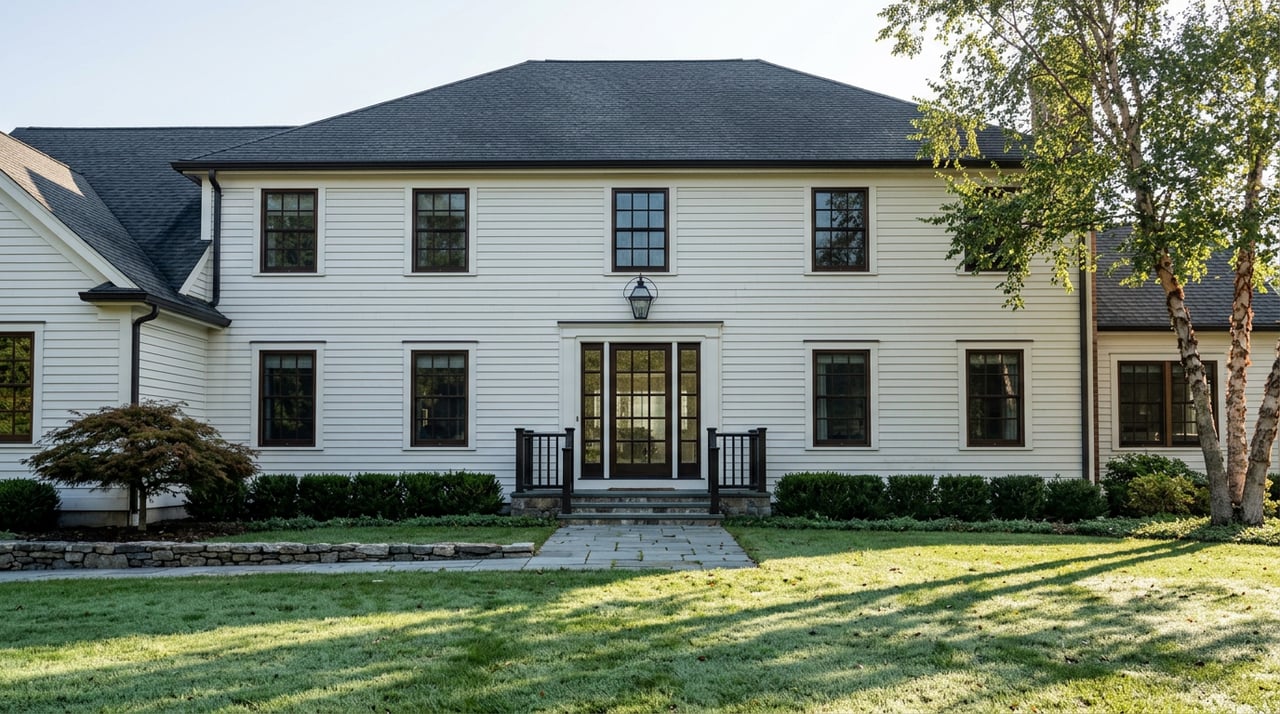
When architect David Stern and interior designer Diane McCafferty took on a Wellesley project with a client wish list that included a terrace, a pool, a pool house with a roof deck, a hot tub, and a tennis court, they ran into a complication that had nothing to do with square footage. A 1930s center-hall Colonial already stood on the lot, and the Wellesley Historical Commission had listed it as preferably preserved. Under the town's demolition-review bylaw, tearing it down would trigger a twelve-month wait before a demolition permit could even be issued.
Most people hear "twelve-month delay" and start planning around a lost year. Stern and McCafferty didn't wait it out. They built around the old Colonial instead, folding a chunk of the original structure into a limestone-clad, thoroughly modern estate. The finished house reads as contemporary from the back and carries a slice of the 1930s original up front. Stern later joked that he and his wife are "making Wellesley modern, one house at a time," and the joke has a point: the delay didn't stop the project. It shaped it.
That's the piece of the bylaw that rarely makes it into the generic explainer. The twelve-month number is real, but it's the opening position in a negotiation, not a fixed sentence. Understanding how that negotiation actually plays out, what it costs, and what the Historical Commission asks for in return, matters more to a Wellesley buyer or renovator than the headline timeline ever will.
The Number Everyone Quotes, and the Number That Actually Happened
The bylaw took effect in mid-August 2017. In its first four months, the Town's Planning Department fielded 37 Eligibility Notice applications, the first step for anyone proposing to demolish a home built before 1950. Eleven were too new to qualify. Of the 22 that were eligible for further review, 12 were cleared for demolition outright and 7 were deemed preferably preserved, meaning a twelve-month clock started ticking.
Here's the part that matters: of those 7 homes carrying a twelve-month delay, 5 immediately filed for a waiver to shorten or eliminate it. That's not a fringe workaround discovered years later. It was the standard response from the bylaw's first season on the books. The delay was never designed, in practice, to run its full course for most owners who received it. It was designed to force a conversation with the Historical Commission, and owners have been having that conversation since week one.
How Rarely the Label Even Gets Applied
Before worrying about the waiver process, it's worth knowing how narrow the target actually is. At a July 2024 Historical Commission meeting, a member noted that Wellesley has roughly 560 houses built before 1900, and only 19 of them had gone through the demolition delay process at all since 2017. That's a small fraction of the town's oldest housing stock, let alone its full inventory of pre-1950 homes eligible for review.
The takeaway for a buyer touring an older Wellesley property isn't that every vintage home carries this risk. It's that when a home does get flagged, the process that follows is well-worn territory for the Commission, not a rare or improvised event. There's a playbook, and the playbook runs through the waiver.
What a Waiver Actually Costs You
The fee schedule is almost beside the point. As of a February 2026 update, an Eligibility Notice runs $50, a full Preservation Determination is $850, and filing for a waiver itself costs nothing. The town's preservation planner is paid $800 to research a home's history and prepare a report for the Commission's review. None of that is the real price of a waiver.
The real price shows up in the design conditions attached to approval. Three cases from the Commission's own January 2026 meeting show what that looks like in practice:
- At 45 Windsor Road, a property that had come before the Commission three separate times, the waiver was approved only after the applicant agreed to dark-sky-compliant lighting, town engineer sign-off on groundwater flow and infiltration, and a arrangement where a specific commissioner would hold final approval over the home's roofline, doorway, and pediment design. The property's landscape architect, Katya Podsiadlo, presented a plan preserving 95 percent of the existing trees, with only two trees over six inches in diameter slated for removal.
- At 10 Alba Road, the Commission approved a waiver contingent on the applicant adopting a specific revised design option out of several presented at the meeting.
- At 31 Old Farm Road, a waiver was approved outright following discussion at the same session.
None of these owners waited twelve months. All of them negotiated. The trade wasn't time for money. It was time for design control, handed in varying degrees to the Commission or its designated members.
Building Around the Delay Instead of Fighting It
The Stern and McCafferty project is the clearest illustration of what happens when an owner treats the bylaw as a design constraint rather than an obstacle to litigate around. Rather than pursuing a waiver to clear the full lot, the team kept the original brick section of the preferably-preserved Colonial and built the new limestone-clad program around and behind it, connecting old and new through a stairway with steel-and-glass floors and open stair risers. The fieldstone pool house, tucked into the backyard program, holds a fireplace, a Ping-Pong table, a kitchenette, and storage, doing double duty as both amenity and buffer between the historic front and the more informal rear.
The project's builder was The Lagassé Group, with Sudbury Design Group handling the landscape. None of that team treated the demolition delay as dead time. They treated it as the reason the house has the layered character it does now, a formal Wellesley front giving way to something looser and more contemporary in back.
What This Means If You're Buying or Renovating an Older Wellesley Home
If you're under agreement on a pre-1950 Wellesley property and planning significant work, the practical question isn't "will I lose a year." It's "what will I need to give up to move faster." Based on the pattern in the Commission's own case files, that usually means one or more of the following: a tree preservation plan that limits which mature trees can come down, exterior lighting standards tied to dark-sky compliance, engineering sign-off on drainage and groundwater impact, or ceding final say on street-facing design elements like rooflines and doorways to a Commission member.
None of that shows up on a listing sheet. It shows up in a public hearing, and it shows up faster for owners who bring a landscape plan, an engineering report, and a redesigned proposal to the table rather than simply requesting relief. The Commission has consistently rewarded applicants who arrive with specifics, not just a request to be let out of the delay.
For a seller, this cuts the other way. A home carrying a preferably-preserved designation isn't a liability to hide. It's a known process with a documented outcome pattern, and a buyer's team that understands the waiver mechanism will see it as a manageable negotiation rather than a dealbreaker.
Wellesley's oldest housing stock is part of what gives the town its character from one street to the next, and the demolition-review bylaw exists precisely to slow down decisions that would erase that character permanently. Knowing how the waiver process actually works, not just the headline delay, is what separates a buyer who walks away from an older Wellesley home and one who ends up with a project like the one on Windsor Road, worth building around instead of over.
If you're evaluating an older Wellesley property, whether you're weighing a renovation, a partial rebuild, or simply want to understand what a preferably-preserved designation would mean for your timeline, the Donahue | Maley | Burns Team has walked clients through this exact process. Schedule your complimentary home valuation and we'll help you read what a specific property's history actually means for your plans, not just what the bylaw says on paper.